Electric vs Gas Quad Bikes in Dubai: Pros, Cons, Real Costs
Electric vs Gas Quad Bikes in Dubai: Pros, Cons, Real Costs
Quad bikes are a Dubai rite of passage. From sunrise runs at Al Qudra to carving the red dunes of Lahbab, they're an easy way to tap into the desert without a racing license. If you're choosing between electric and gas, though, the answer isn't just about speed. Dubai's heat, charging and fuel access, maintenance, and resale market all tilt the equation in specific ways. Here's a practical, human take on what actually matters-and what it will really cost you.
How Dubai changes the question
Electric and gas machines behave differently in any country, but two Dubai realities matter most:
Heat: Summer ambient temps of 40–48°C stress batteries and cooling systems. Electric powertrains can throttle to protect cells; gas engines can overheat if airflow is poor. Both require some mechanical sympathy.
Access: Petrol is everywhere; chargers are not. Most electric quads charge from a 220–240V wall socket at home; there are few, if any, public off-road charging options near the dunes.
The essential comparison
Performance in sand
Gas: Lighter for the power, proven in dunes. Throttle response is predictable, refuelling is instant, and cresting dunes is all about momentum-weight matters. Popular picks like Yamaha's Raptor 700R, Honda TRX, and Can‑Am Renegade are well supported locally.
Electric: Immediate torque is fantastic at low speed and on technical climbs. But extra battery weight can work against you in soft sand, and sustained high load in heat may trigger thermal limits. For short sessions near camp, they're a joy; for long dune loops, range anxiety is real.
Range and refuelling/charging
Gas: A 10–14 litre tank typically gives 2–4 hours of mixed dune riding. Top-up takes minutes; jerrycans are simple.
Electric: Typical ATV packs are roughly 6–14 kWh. Home charging on a 220V socket often takes 3–8 hours depending on battery size and charger. Fast charging is rare on quad platforms. Real-world dune runtime can be 60–120 minutes before you feel the drop-off.
Noise and neighbor-friendliness
Gas: Loud, which is part of the fun, but not great near residential edges or cycling tracks. Some areas and times frown on noise; it's also tiring on long rides.
Electric: Whisper-quiet. You hear the sand, your tires, and the wind. Better for early mornings and for not annoying everyone within earshot.
Maintenance and reliability
Gas: Routine oil and filter changes, air filter cleaning (constant in sand), spark plugs, belts/clutches (on CVT models), and occasional valve checks. Service intervals often 50–100 hours. Parts and expertise are everywhere in the UAE.
Electric: Fewer moving parts; most upkeep is tires, brake pads, bearings, and keeping connectors clean. Batteries are the wild card-heat accelerates aging. Good thermal management and smart storage habits help.
Availability and support in Dubai
Gas: Excellent. Dealers, independent shops, and a healthy used market. Easy to rent for try-before-you-buy.
Electric: Improving but still niche in the quad segment. Some specialty dealers can import models; parts may involve longer lead times.
Quad Biking Dubai Without License – Turns out freedom doesn’t need paperwork.
Quad Bike Dubai Evening Tour – Cooler air, hotter action.
Quad Bike Dubai Short Desert Tour – Perfect for thrill-seekers on a schedule.
Quad Biking Dubai Private Tour – Just you, your quad, and the dunes listening quietly.
Electric side-by-sides (UTVs) are ahead of quads in availability.
Rules and where you can ride
ATVs are generally off-road only in Dubai; don't plan on public-road transits. Wear a helmet and full protective gear.
For registration/insurance specifics, check with RTA and your insurer; off-road policies exist. Commercial tour operators have their own compliance requirements.
The real costs in Dubai
Purchase price (new, typical)
Gas quads: roughly AED 30,000–50,000 depending on displacement and brand; high-performance models can exceed that.
Electric quads: roughly AED 45,000–90,000 for credible, adult-sized machines. Niche imports can swing higher. Quad Biking Dubai Safe Tours – Thrills without the stress. Electric UTVs are more.
Energy costs
Petrol: UAE pump prices fluctuate monthly; in recent years, think roughly AED 2.7–3.5 per litre.
Electricity (home): DEWA residential tariffs vary by slab and surcharges; a practical range is around AED 0.23–0.45 per kWh.
Consumption (realistic dune use)
Gas: 4–7 litres per hour depending on rider, engine size, tire pressure, and sand softness.
Electric: 5–10 kWh per hour in dunes; heavy throttle and heat push you to the top end.
What that means per hour
Gas fuel: roughly AED 11–25/hour.
Electric energy: roughly AED 1–5/hour at home rates.
Maintenance and wear (annual ballparks for a recreational rider)
Gas: AED 1,500–3,000 for routine service and consumables, not counting crash damage. Add AED 800–1,500 if you roast a belt or clutch in dunes.
Electric: AED 800–1,500 for tires, pads, and general upkeep; minimal fluids. Battery replacement is the big variable.
Battery realities
Modern lithium packs can last 800–1,500 cycles under kind conditions. Dubai heat and frequent 100% charges shorten that. If a pack costs AED 5,000–15,000 and lasts 3–6 years for a weekend rider, that's roughly AED 1,000–4,000 per year in eventual amortization. Good storage (cool, shaded), avoiding full charges when not riding, and not running to empty help.
Insurance, gear, and transport
Both types: similar insurance options for off-road; expect hundreds to around a thousand dirhams per year depending on coverage and use. Quality helmet/gear might run AED 1,000–2,000. Many owners also factor a trailer or pickup.
Worked examples
The casual weekender
Use: 2 hours, twice a month (48 hours/year), mostly winter.
Electric: Energy ~ 150 × 8 kWh × AED 0.30 ≈ AED 360; maintenance ~ AED 1,200–1,800; battery amortization likely at the high end ~ AED 2,500–4,000; total ~ AED 4,000–6,000. Note: summer heat may force shorter sessions or cooldowns.
Tourist alternative: Renting
Gas quad rentals are widely available: roughly AED 250–500 for a basic 1‑hour session; high-performance or guided dunes can be AED 600–1,000+. Electric rental options are rare. If you ride fewer than 6–8 times a year, renting is often cheaper than ownership once you include purchase, registration/insurance, gear, and transport.
Environmental angle
Gas: Direct tailpipe emissions and noise.
Electric: No local emissions; Dubai's grid is increasingly solar-powered, but total footprint depends on generation mix. In practical terms, electric wins on air quality and noise where you ride.
Heat management tips for both
Ride early. Summer midday rides are punishing for machines and people.
Run correct tire pressures for sand; don't overtax the drivetrain.
For electric: store and charge in the coolest spot you can; avoid full-charge storage; don't repeatedly deep-discharge.
For gas: keep air filters clean, monitor coolant/oil temps, and let the engine cool after sustained climbs.
So, which should you buy?
Choose gas if:
You want maximum range and flexibility for long dune days.
You value proven platforms, abundant parts, and a strong resale market in the UAE.
You'll be riding far from any power source and don't want to manage charging windows.
Choose electric if:
You ride in shorter stints from home, care about quiet and clean operation, and can charge between sessions.
You're comfortable paying more upfront and managing battery health for lower running costs.
You mostly ride cooler months or times of day where thermal throttling is unlikely.
Practical buying advice for Dubai
Test in sand, not just on hardpack. Quad Biking Dubai with Hotel Pickup – From hotel lobby to desert legend. Torque curves and weight feel very different off-road.
Check dealer proximity and parts availability; ask what's in stock versus special order.
For electric, ask about battery chemistry, cooling, replacement cost, and warranty terms in high-heat climates.
For gas, get a service schedule and parts pricing for filters, belts, and clutches-these are your regular bills.
Verify insurance options for your intended use and confirm off-road legality for the areas you plan to ride.
Quad Biking Dubai Safe Tours – Thrills without the stress.
Quad Biking Dubai Signature Experience – The experience people mean when they say “Dubai adventure.”
Bottom line
In Dubai, gas quads remain the default for all-day dune adventures and simple logistics. Electric quads are delightful for quieter, shorter sessions with ultra-low energy costs-especially if you can charge at home and ride outside the hottest hours. Safest Quad Bike Dubai Tours for Seniors . The “cheaper to run” advantage of electric is real on energy and basic maintenance, but the battery is the swing factor. If your riding style and schedule fit the electric envelope, you'll love the silence and instant torque. If you want maximum range, minimal planning, and bulletproof support across the Emirates, a gas quad still makes the most sense.
As always in Dubai, check current petrol prices, DEWA tariffs, and local regulations before you decide; they move, and your costs will move with them.
Quad Biking Dubai Safe Tours – Thrills without the stress.
Quad Bike Dubai Sharjah Border – Ride where Dubai excitement meets Sharjah calm.
Quad Biking Dubai Holiday Activity – The highlight you’ll talk about all year.
About Corporate travel management
"Corporate Travel Management" redirects here. For the company of that name, see Corporate Travel Management (company).
This article needs additional citations for verification. Please help improve this article by adding citations to reliable sources. Unsourced material may be challenged and removed. Find sources: "Corporate travel management" – news · newspapers · books · scholar · JSTOR(December 2021) (Learn how and when to remove this message)
Corporate travel management is the function of managing a company’s strategic approach to travel (travel policy), the negotiations with all vendors, day-to-day operation of the corporate travel program, traveler safety and security, credit-card management and travel and expenses ('T&E') data management.
CTM should not be confused with the work of a traditional travel agency. While agencies provide the day-to-day travel services to corporate clients, they are the implementing arm of what the corporation has negotiated and put forth in policy. In other words, CTM decides on the class of service which employees are allowed to fly, negotiates corporate fares/rates with airlines and hotels and determines how corporate credit cards are to be used. The agency on the other hand makes the actual reservation within the parameters given by the corporation.
For many companies, T&E costs represent the second highest controllable annual expense, exceeded only by salary and benefits, and are commonly higher than IT or real estate costs. T&E costs are not only limited to travel (airline, rail, hotel, car rental, ferry/boat, etc.) but include all costs incurred during travel such as staff and client meals, taxi fares, gratuities, client gifts, supplies (office supplies and services), etc. Furthermore, this area often includes meeting management, traveler safety and security as well as credit card and overall travel data management.
The management of these costs is usually handled by the Corporate Travel Manager, a function which may be part of the Finance, HR, Procurement or Administrative Services Department.
Effective corporate travel management goes beyond mere cost control; it plays a pivotal role in enhancing employee satisfaction and retention. Travel policies tailored to the needs of the workforce can significantly improve job satisfaction by reducing travel-related stress and ensuring that employees feel valued and cared for during their travels. Moreover, advanced analytics and travel data management enable corporations to make informed decisions that can lead to more strategic travel planning and potential savings.
As businesses become increasingly global, the ability to manage travel effectively becomes a competitive advantage, allowing companies to nurture important client relationships and facilitate essential face-to-face interactions in an increasingly digital world.
Global Consolidations
[edit]
Many companies, especially large multinationals (MNC), opt for global consolidation of their travel procurement. In other words, they may choose to put their entire purchasing of travel arrangements in the hands of one Travel Management Company (TMC). This is almost always done with a global Request for Proposal (RFP), through which the company will invite major TMCs to participate in the RFP. The process and the selection of the TMC could take several months. Once the company has chosen its TMC, the handling of their travel arrangements will be handled by the selected TMC throughout the world. There could, of course, be exceptions in certain countries.
The advantages of a global consolidation lie in the game of numbers: the company will be able to bring to the table the advantage of global numbers when negotiating with suppliers. These negotiations could include airlines, hotel chains, individual hotels (for specific reasons), car-rental companies, etc. The main goal of going the route of global consolidation is to create savings in the company's T&E budget. [citation needed]
Travel Management Companies
[edit]
Main article: Travel management company
The implementation of corporate travel management is often delegated to Travel Management Companies (TMC). A TMC will manage an organization's corporate or business travel program. They will often provide an online booking tool,[1] mobile application, program management and consulting teams, executive travel services, meetings and events support, reporting functionality, and potentially others. These companies have historically used Global Distribution Systems (GDS) to book travel for their clients though these systems no longer provide complete content so these gaps need to be filled by additional aggregated, non-GDS, content.[2] This allows the travel consultant to compare different itineraries and costs by displaying availability in real-time, allowing users to access fares for air tickets, hotel rooms and rental cars simultaneously.[3]
Travel Management Lite
[edit]
Travel Management Lite, is a lightweight version of a Corporate Travel Management solution, generally used by SMEs and growth companies who don't require extensive or bespoke solutions offered by TMCs. The main advantage to a Lite solution is to enhance real-time transparency in travel spending across the company, and provides access to mobile and web apps needed to book and manage a company's travel. This allows business travelers, assistants, and travel managers to book more efficiently, and have faster access to support, than were they to use different leisure booking sites or offline travel agents.[4]
Ground Transportation Management
[edit]
A large part of corporate transportation management covers Ground Transportation Management (GTM), which is provided by business travel agencies and business-to-business software vendors for corporate clients to consolidate and streamline the management of their ground transportation suppliers primarily to optimize travel costs, scheduling and organization.[5]
In the corporate travel management system, GTM companies play a role of aggregator or virtual hubs for all ground transportation-related services. They act as mediators using databases, global distribution systems (GDS) and various industry-related platforms such as taxi and ridesharing companies,[6] corporate fleets, public transportation and other alternatives to find optimal journeys for the travel users.[7][8]
However, in the 21st century, GTMs' activity is not limited to a database search or benchmark pricing comparisons for transportation needs but encompasses a wide spectrum of business categories including travel assistance, accounting, expenditure management and travel analysis, among others.[5]
Similar to the other types of transportation management companies, the quality of the company software and its integration with the cloud remain critical for coordination of transportation flow through scaling of different vendors and services to the needs of corporate clients.
Examples of companies in this category are Gett, AMEX GBT, Amadeus with those in business spend management such as Coupa, Expensify, and ExpenseOut.
Like most of the companies related to tourism and travel economy, the GMT business sector has been hit hard by the ongoing COVID-19 pandemic and travel restrictions in many countries around the world.[7][9] However, with the vaccinations running in many countries, the GTM sector has shown some signs of recovery.[10][11]
References
[edit]
^
"Corporate Booking Tool [CBT]". TravelPortalSolution.com. 16 December 2022. Retrieved 8 September 2023.
^"Travel Management Companies Battle the Content Gap". www.businesstravelnews.com. 28 October 2018. Retrieved 11 June 2021.
^What is a TMC?. Youtube.com. Retrieved on 2017-11-23.
^www.ETCIO.com. "Cleartrip launches 'Out of Office,' a corporate travel management product - ET CIO". ETCIO.com. Retrieved 20 May 2024.
^ ab"What Is Travel Management?". BizFluent.
^"Uber and Lyft Achieve Record Popularity". Global Business Travel Association. 30 July 2019.
^ ab"Ground Transportation, Overlooked but Essential, Needs More Relief". Business Traveler news. 8 April 2020.
^"Airport Industry Headlines". Airport Improvement. July 2020.
^"Trends and opportunities for ground transportation". Travel Daily News. 27 October 2020.
^"Return to a world transformed: How the pandemic is reshaping corporate travel". Deloitte Insights.
^"The comeback of corporate travel: How should companies be planning?". McKinsey & company.
v
t
e
Aspects of corporations
Abuse
Appointeeship
Citizenship
Communication
Crime
Despotism
Entertainment
Ethics
Corporate haven
Identity
Interlocks
Liability
Machiavellianism
Narcissism
Nationalism
Opportunity
Pathos
Power
Promoter
Propaganda
Psychopathy
Raid
Recovery
Resolution
Scandals
Security
Services
Social entrepreneurship
Social media
Social responsibility
Sourcing
Statism
Sustainability
Synergy
Tax
Taxonomy
Title
Trainer
Transparency
Travel
Trust
Veil
Video
See also templates
Aspects of jobs
Aspects of occupations
Aspects of organizations
Aspects of workplaces
Corporate titles
Portal:
Companies
About Travel agency
Retailer that provides tourism-related services
The examples and perspective in this article may not represent a worldwide view of the subject. You may improve this article, discuss the issue on the talk page, or create a new article, as appropriate.(August 2018) (Learn how and when to remove this message)
Allamanda Voyages travel agency in ParisTravel agency in Rio de Janeiro, BrazilTravel agency in Taiwan
A travel agency is a private retailer or public service that provides travel and tourism-related services to the general public on behalf of accommodation or travel suppliers to offer different kinds of travel packages for each destination.
Travel agencies can provide outdoor recreation, arranging logistics for luggage and medical items delivery for travellers upon request, public transport timetables, car rentals, and bureau de change services. Travel agencies can also serve as general sales agents for airlines that do not have offices in a specific region. A travel agency's main function is to act as an agent, selling travel products and services on behalf of a supplier. They are also called Travel Advisors. They do not keep inventory in-hand unless they have pre-booked hotel rooms or cabins on a cruise ship for a group travel event, such as a wedding, honeymoon, or other group event.
In the decades after World War II, travel and migration agencies also played a role in assisting international migration, alongside state programmes and intergovernmental organisations such as the Intergovernmental Committee for European Migration (ICEM, now the International Organization for Migration.).[1]
Business model
[edit]
Travel agencies often receive commissions and other benefits and incentives from providers or may charge a fee to the end users.[2] Hotel owners and tour operators typically pay a higher commission rate to travel agencies, whereas airlines typically pay no commission.[3] The customer is normally not made aware of how much the travel agent is earning in commissions and other benefits.[4] A 2016 survey of 1,193 travel agents in the United States found that on average 78% of their revenue was from commissions and 22% was generated from fees.[5]
Accreditation number
[edit]
Travel agencies are recognized by vendors through their accreditation numbers. In the United States, the main accreditation numbers are issued by Airline Reporting Corporation, Cruise Lines International Association, International Air Transport Association.
If more than one travel agency is booking under the same accreditation number, the agency of record is called a host agency.[6] This is a popular model in the United States, with surveys show anywhere from 43-85% of leisure agencies now booking under a host agency.[7][8][9]
Travel technology
[edit]
Travel agencies use the services of the major computer reservations systems, also known as global distribution systems (GDS), including: Amadeus CRS, Galileo GDS, Sabre, and Worldspan, which is a subsidiary of Travelport, which allow for comparison and sorting of hotel and flight rates with multiple companies.[10] Bookings made via travel agents, including online travel agents, may or may not be confirmed instantly. Unlike online travel agencies, metasearch engines and scraper sites, such as Skyscanner, Kayak.com, Rome2rio, and TripAdvisor, travel agencies may or may not have their own booking engine, and instead provide results for search queries and then divert traffic to service providers or online travel agencies for booking.[11][12][13][14] Travel agents may also work with airline consolidators.[15][16]
Some companies use technology to promote sustainable tourism and bring carbon-neutrality.[17]
Types of travel agencies
[edit]
Traditional travel agencies
[edit]
A traditional travel agent may work for a travel agency or work freelance.[18][19][20] Many traditional agents prefer the term "travel advisor" as opposed to "travel agent" to emphasize their advice, expertise, and connections that are of great value.[21] While most point-to-point travel is now booked online, traditional agents specialize in niche markets such as corporate travel, luxury travel, cruises, complicated and important trips, and specialty trips.[22] Other niche markets for traditional travel agencies include travelers with disabilities, travelers over the age of 60, women traveling alone, LGBT tourism,[23] or a particular group interested in a similar activity, such as a sport.[24][25]
Franchise travel agencies
[edit]
Helloworld Travel is an example of a franchised travel agency, giving agents access to internal systems for product and bookings.[26]
Online travel agencies
[edit]
A online travel agency (OTA) uses a platform business model to generate revenue. The Expedia Group is the largest OTA globally. Booking Holdings is the second largest OTA.[27]
Licensing
[edit]
In many countries, all travel agencies are required to be licensed by the International Air Transport Association (IATA).[28] Many are also bonded and represented by IATA, and, for those that issue air tickets, the Air Travel Organisers' Licensing (ATOL) in the United Kingdom, and the Airlines Reporting Corporation in the United States also serve those purposes.[29] ABTA – The Travel Association the Association of Canadian Travel Agencies (ACTA) The American Society of Travel Advisors (ASTA), represent travel agencies in the United Kingdom, Canada, and the United States respectively.[30][31]
History
[edit]
In 1758, Cox & Kings became the first travel agency in modern history.[32][33]
In 1840, the Abreu Agency was established in Porto by Bernardo Abreu, becoming the world's first agency to open its services to the public.
A Thomas Cook travel agency in the United Kingdom, which ceased operating in 2019.
In 1841, Thomas Cook, a Baptist preacher who believed that alcohol was to blame for social problems, reached an agreement with the Midland Railway to organize the transportation of 500 members of his temperance movement from the Leicester Campbell Street railway station to a rally in Loughborough in exchange for a commission.[34][35] He formed Thomas Cook & Son, which later became The Thomas Cook Group. It filed bankruptcy and underwent liquidation in 2019.[36]
In 1871, Dean and Dawson was founded in the United Kingdom and in the 1950s, it was acquired by Thomas Cook.[37]
In 1870, the Polytechnic Touring Association was founded in the United Kingdom.
In 1887, Walter T. Brownell established Brownell Travel, the first travel agency in the United States, and led 10 travelers on a European tour setting sail from New York on the SS Devonia.[38]
In 1895, Baldwins Travel was founded by Alfred K Baldwin, originally a printer, bookbinder and publisher in Tunbridge Wells. Baldwins begins selling railway tickets and helping friends to travel to Europe and beyond. News spreads and the former printers slowly build a strong side-line in travel at the back of the Baldwins Stationery shop at 27 Grosvenor Road.[39]
In 1905, Nippon Travel Agency became the first travel agency in Japan.[40]
Originally, travel agencies largely catered to middle and upper-class customers but they became more commonplace with the development of commercial aviation.
In 1923, after being treated badly by a British travel agency, K. P. Chen formed what became the China Travel Service, the first travel agency in China.[41]
The industry suffered during World War II. However, the Post–World War II economic expansion in mass-market package tours resulted in the proliferation of travel agencies catering to the working class.[42]
In 1929, Intourist was formed as the official state travel agency of the Soviet Union, with the goal of convincing outsiders to visit the country.[43]
In 1931, the US trade organization ASTA (originally the American Steamship and Tourist Agents Association, now the American Society of Travel Advisors) was created.[44]
During the Cold War, travel agents were used by people from Western countries to travel behind the Iron Curtain.[45]
In the early Cold War period, new intergovernmental programmes helped organise and subsidise long-distance migration from Europe, including the Provisional Intergovernmental Committee for the Movement of Migrants from Europe (PICMME), renamed the Intergovernmental Committee for European Migration (ICEM). In some countries, travel and migration agencies viewed these programmes as both competition and a source of new business opportunities, as the administration of passports, consular procedures, medical checks, and transport became more bureaucratised and commercially mediated.[46]
In 1951, the precursor to Helloworld Travel became one of the first travel agencies in Australia.
In 1955, Henderson Travel Service in Atlanta, Georgia became the first African-American-owned travel company and the first to take large groups of black American tourists to Africa.[47][48]
A Keihäsmatkat advertisement from Rhodes in 1971.
In the early 1980s, American Airlines' Sabre unit created a direct-to-consumer booking tool[clarification needed] for flights, hotels and cars called eAAsySabre.[49]
In 1989, with the liberalization of travel for South Koreans, Mode Tour became the first travel agency in the country.[50]
In 1991, Hotel Reservations Network, the precursor of Hotels.com, was founded. At first, hotels did not pay much in commissions.[49]
With the advent of the internet, travel agencies migrated online and underwent disintermediation by the reduction in costs caused by removing layers from the package holiday distribution network.[51]
In 1994, Travelweb.com launched as the first online directory of hotels.[52]
In 1995, Internet Travel Network sold the first airline ticket via the World Wide Web.[52]
In October 1996, Expedia.com, funded with hundreds of millions of dollars by Microsoft launched as the first large online travel agency.[49]
At the same time, Cheapflights started as a listing service for flight deals from consolidators.[49]
In 1998, Lastminute.com was founded in the United Kingdom.[52]
In 1999, Expedia went public on the Nasdaq stock exchange. From 1999 to 2006, the number of travel agents in the United States plunged from 124,000 to 88,000 as many Americans switched to making their own travel arrangements online.[53]
Also in 1999, European airlines began eliminating or reducing commissions,[54] while Singapore Airlines did so in parts of Asia. In 2002, several airlines in the United States did the same, which led to an unsuccessful lawsuit alleging collusion among the airlines, that was decided on appeal in 2009.[55][56]
In 2007, the launch of the iPhone and related mobile apps increased travel bookings made online.[52]
In 2008, the launch of Airbnb created an online marketplace for spare bedrooms and apartments.[52]
In 2011, the launch of HotelTonight highlighted instantaneous same-day hotel room booking.[52]
In 2021, travel agency Baldwins Travel Group, which was founded in 1895 was bought by business group[57] Inc & Co.
Outlook
[edit]
According to the United States Bureau of Labor Statistics, in 2022, there were 66,300 people who were employed as travel agents for their full-time jobs. That number is projected to increase by 3% over the next 10 years. In 2022, the BLS lists the median travel agent salary as $46,400 per year.[58]
Host Agency Reviews lists employee salaries by compensation structure, listing the 2022 income for travel agents that earn salary + commissions (25% of travel advisor employees) at $88,909, those that earn salary/hourly only at $50,792 (44% of employee travel agents), and commission only travel employees at $21,932 (31%).[59]
However, job prospects should be best for travel agents who specialize in specific destinations or particular types of travelers.
Several reports show that the number of people using travel agents to book travel has been increasing.[60][61][62][63]
See also
[edit]
Travel agency at Wikipedia's sister projects
Definitions from Wiktionary
Media from Commons
Travel information from Wikivoyage
Destination marketing organization
Hotel consolidator
Tour guide
Tour operator
Tourism minister
References
[edit]
^
Limnios-Sekeris, I. (2025). "An entrepreneurial turf war: Travel agencies, ICEM, and the migration industry since the 1950s". Business History: 1–22. doi:10.1080/00076791.2025.2558764.
^Morello, Robert. "How Does a Travel Agency Make Money?". Archived from the original on 18 November 2012. Retrieved 8 November 2019.
^"Travel providers which pay travel agency commission". Statista. Archived from the original on 9 August 2020. Retrieved 10 May 2020.
^"Five myths about travel agents". USA TODAY. 25 September 2014. Archived from the original on 26 September 2014. Retrieved 17 September 2017.
^Lock, S. (11 July 2018). "Travel agency industry – Statistics & Facts". Statista. Archived from the original on 8 November 2019. Retrieved 8 November 2019.
^"What is a host agency?". Host Agency Reviews. 26 February 2024. Retrieved 28 March 2024.
^Rokou, Tatiana (6 September 2023). "The Travel Institute's New Survey Signals Need for Additional Agent Recruitment and Retention". Retrieved 28 March 2024.
^"US Travel Agency Landscape 2024". Phocuswright. Retrieved 28 March 2024.
^"Hosted Travel Advisor Report 2023". 30 September 2023. Retrieved 28 March 2024.
^McGee, Bill (11 February 2014). "What's the best airfare metasearch site?". USA TODAY. Archived from the original on 11 February 2014. Retrieved 17 September 2017.
^Sharma, Animesh K.; Sharma, Rahul (2022). "Identification of the Customers' Preferred Attributes while Selecting an OTA (Online Travel Agency) Platform". Indian Journal of Marketing. 52 (7): 43–55. doi:10.17010/ijom/2022/v52/i7/170538. S2CID 250639540.
^"Metasearch and OTAs: Do You Know the Difference?". Trivago. 7 April 2016. Archived from the original on 8 November 2019. Retrieved 8 November 2019.
^Grannell, Craig (10 April 2017). "The best flight search websites – tried and tested". The Daily Telegraph. Archived from the original on 12 January 2022.
^Sorrells, Mitra (22 October 2018). "The metasearch model, part 3: The complexity of multimodal". Phocuswire. Archived from the original on 10 November 2019. Retrieved 10 November 2019.
^Blažić, Goran (3 October 2019). "10 Reasons: Why Travel Agents like to work with Airline Consolidators". Today American TV program. Archived from the original on 9 August 2020. Retrieved 10 May 2020.
^BURGESS, BONNIE (23 September 2019). "What Travel Agents and Customers Need to Know About Using Airfare Consolidators". TripSavvy. Archived from the original on 9 August 2020. Retrieved 10 May 2020.
^"10 eco-friendly travel companies you can feel good about booking with". Time Out Worldwide. Archived from the original on 20 April 2023. Retrieved 20 April 2023.
^"Power List coverage". Travel Weekly. Archived from the original on 12 November 2019. Retrieved 8 November 2019.
^"How to Become a Travel Agent". Host Agency Reviews. 5 May 2023. Retrieved 28 March 2024.
^Khwaja, Ameen (1 February 2008). "How to Start a Travel Service". Entrepreneur magazine. Archived from the original on 24 September 2011. Retrieved 20 October 2016.
^Olmsted, Larry (20 January 2012). "Why You Need A Travel Agent, Part 1". Forbes. Archived from the original on 8 November 2019. Retrieved 8 November 2019.
^Weber, Rebecca L. (10 October 2013). "The travel agent is dying, but it's not yet dead". CNN. Archived from the original on 8 November 2019. Retrieved 8 November 2019.
^Petersen, Lainie (19 March 2019). "Impact of Technology on the Travel Agency Business". Houston Chronicle. Archived from the original on 8 November 2019. Retrieved 8 November 2019.
^LAM, BOURREE (22 June 2016). "Who Uses a Travel Agent in This Day and Age?". The Atlantic. Archived from the original on 8 November 2019. Retrieved 8 November 2019.
^Braga, Matthew (18 March 2016). "Why Are Travel Agents Still a Thing?". Vice Media. Archived from the original on 8 November 2019. Retrieved 8 November 2019.
^"How Do I Set Up a Travel Agency and Tour Arrangement Company?". LegalVision. 28 April 2016. Archived from the original on 22 October 2018. Retrieved 22 October 2018.
^Alastair M. Morrison (2022). Tourism Marketing: In the Age of the Consumer. Taylor & Francis. ISBN 9781317929659.
^"IATA – Become an IATA Agent". International Air Transport Association. Archived from the original on 8 November 2019. Retrieved 8 November 2019.
^"IATA – About Us". International Air Transport Association. Archived from the original on 4 April 2010. Retrieved 8 November 2019.
^"ASTA: Representing Travel Advisors and the Traveling Public for 85 Years". American Society of Travel Advisors. Archived from the original on 28 February 2021. Retrieved 11 January 2021.
^"ABTA: About us". ABTA – The Travel Association. Archived from the original on 23 September 2019. Retrieved 8 November 2019.
^"Establishment of Cox & Kings". Archived from the original on 8 November 2019. Retrieved 8 November 2019.
^Turen, Richard (17 August 2008). "The world's oldest travel company". Travel Weekly. Archived from the original on 8 November 2019. Retrieved 8 November 2019.
^CAMERON, MIKE (7 October 2013). "A Brief Overview And Evolution Of The Travel Industry". Christopherson Business Travel. Archived from the original on 8 November 2019. Retrieved 8 November 2019.
^Kayleigh (16 August 2018). "The first travel agency organized train excursions". Medium.
^Cripps, Karla (23 September 2019). "Thomas Cook: A history of one of the world's oldest travel firms". CNN. Archived from the original on 28 September 2019. Retrieved 8 November 2019.
^"Dean and Dawson Limited 1871". Science Museum Group. Archived from the original on 8 November 2019. Retrieved 8 November 2019.
^"Brownell Travel: About Us". Brownell Travel. Archived from the original on 8 November 2019. Retrieved 8 November 2019.
^"Baldwins Travel Group | The history of Kent and Sussex's award-winning travel agent". www.baldwinstravel.co.uk. Archived from the original on 20 September 2021. Retrieved 20 September 2021.
^"Japan Information". Nippon Travel Agency. Archived from the original on 4 November 2019. Retrieved 8 November 2019.
^Junmian, Zhang (30 October 2011). "Top 10 influential businessmen of modern China". China Internet Information Center. Archived from the original on 8 November 2019. Retrieved 8 November 2019.
^"History of the Travel Agent Industry". 25 February 2015. Archived from the original on 21 April 2016. Retrieved 10 May 2020.
^"The vintage posters that lured travelers to Stalin's Soviet Union". The Daily Telegraph. 28 June 2018. Archived from the original on 12 January 2022.
^"ASTA: About Us". American Society of Travel Advisors. Retrieved 28 March 2024.
^Pedersen, Sune Bechmann (28 May 2018). "Eastbound tourism in the Cold War: the history of the Swedish communist travel agency Folkturist". Journal of Tourism History. 10 (2). Taylor & Francis: 130–145. doi:10.1080/1755182X.2018.1469679.
^Limnios-Sekeris, Ioannis (21 October 2025). "An entrepreneurial turf war: Travel agencies, ICEM, and the migration industry since the 1950s". Business History. doi:10.1080/00076791.2025.2558764.
^Cottman, Michael (27 February 2018). "After six decades, black travel agency continues to help tourists 'embrace' Africa". NBC News. Archived from the original on 29 December 2019. Retrieved 8 November 2019.
^Jamison, Shantell E. (27 February 2018). "Black-owned Travel Agency Wants Tourists to 'Embrace' Africa". Ebony. Archived from the original on 8 November 2019. Retrieved 8 November 2019.
^ abcdSchaal, Dennis. "The History of Online Travel". Skift. Archived from the original on 4 July 2019. Retrieved 7 November 2019.
^Lee, Youjin (14 January 2019). "Why Are So Many South Korean Travel Agencies Closing?". Skift. Archived from the original on 8 November 2019. Retrieved 8 November 2019.
^Andal-Ancion, Angela; Cartwright, Phillip A.; George S., Yip (15 July 2003). "The Digital Transformation of Traditional Business". MIT Sloan Management Review. 44 (4): 34–41. Archived from the original on 7 November 2019. Retrieved 7 November 2019.
^ abcdefMay, Kevin (12 March 2014). "How 25 years of the Web inspired the travel revolution". The Guardian. Archived from the original on 7 November 2019. Retrieved 7 November 2019.
^Cowen, Tyler; Tabarrok, Alex (2010). Modern Principles of Economics (9th ed.). New York: Worth Publishers. p. 513. ISBN 9781429202275. Retrieved 2 January 2023.
^COHEN, AMON (21 February 2000). "British Airways Eliminates Agency Commissions". Business Travel News. Archived from the original on 8 November 2019. Retrieved 8 November 2019.
^"In re Travel Agent Commission Antitrust Litigation". United States District Court for the Northern District of Ohio. 29 October 2007. Archived from the original on 8 November 2019. Retrieved 8 November 2019.
^"IN RE: TRAVEL AGENT COMMISSION ANTITRUST LITIGATION". United States Court of Appeals for the Sixth Circuit. 2 October 2009. Archived from the original on 8 November 2019. Retrieved 8 November 2019.
^Kemble, Harry (14 September 2021). "Baldwins Travel acquired by business investors Inc & Co". Travel Weekly. Jacobs Media Group Ltd. Archived from the original on 20 September 2021. Retrieved 20 September 2021.
^"Occupational Outlook Handbook: Travel Agents". Bureau of Labor Statistics. Retrieved 28 March 2024.
^"2023 Employee Travel Advisor Research Report Summary". Host Agency Reviews. 18 December 2023. Retrieved 28 March 2024.
^D'Ambrosio, Richard (9 August 2019). "Travel Agent Popularity on the Rise Yet Again". Travel Market Report. Archived from the original on 8 June 2020. Retrieved 10 May 2020.
^Shrikant, Aditi (21 September 2018). "How travel agencies avoided extinction and became a luxury service". Vox Media. Archived from the original on 8 June 2020. Retrieved 10 May 2020.
^"State of the Cruise Industry 2023". Cruise Lines International Association. Retrieved 28 March 2024.
^"Travelers Willing to Spend More on Travel, Value the Skills and Knowledge of Travel Advisors". American Society of Travel Advisors. Retrieved 28 March 2024.
v
t
e
Commercial aviation
Airlines
Airline codes
Airline holding companies
Cargo airline
Charter airlines
Flag carriers
Low-cost airlines
Non-scheduled airline
Passenger airlines
Regional airlines
Alliances
Oneworld
SkyTeam
Star Alliance
Value Alliance
Vanilla Alliance
U-FLY Alliance
Trade groups
International
ACO
ATAG
IATA
IATAN
IFALPA
ISTAT
United States
A4A
RAA
Europe
A4E
ASD
ECA
EBAA
ERA
ETWF
Other regions
AACO
AAPA
AFRAA
RAAA
Aircrew
Pilot in command (Captain)
First officer
Second officer
Third officer
Relief crew
Flight attendant
Flight engineer
Loadmaster
Aircraft pilot
Purser
Dead mileage
Airliner
Travel class
First class
Business class
Premium economy class
Economy class
Basic economy class
Aircraft cabin
Aircraft lavatory
Aircraft seat map
Airline meal
Airline seat
Buy on board
Crew rest compartment
In-flight entertainment
Inflight smoking
Galley
Sickness bag
Airport
Aerodrome
Airline hub
Airport check-in
Airport lounge
Airport rail link
Airport terminal
Airside pass
Airstair
Boarding
Domestic airport
Gate
International airport
Jet bridge
Low-cost carrier terminal
Runway
Transit hotel
Customs / Immigration
Arrival card
Border control (internal)
Departure card
Passport
Timatic
Travel document
Travel visa (Electronic)
Environmental effects
Hypermobility
Environmental effects of aviation
Law
Air transport agreement
Air route authority between the United States and China
World Federation of Travel Journalists and Writers
World Tourism Organization
World Tourism rankings
World Travel and Tourism Council
World Travel Monitor
Trade fairs and events
Akwaaba African Travel Market
Arabian Travel Market
Cruise of the Kings
Festival del Viaggio
FITUR
ITB Berlin
World Tourism Day
Issues
Heritage commodification
Impact of the COVID-19 pandemic on tourism
Impacts of tourism
Leakage effect
Overtourism
Tourismphobia
Tourism improvement district
Tourist tax
Lists
Adjectival tourisms
Attractions
Bibliography
Casino hotels
Casinos
Cities by international visitors
Convention and exhibition centers
Cruise lines
Hotels
Largest
Motels
Passenger airlines
UNESCO Intangible Cultural Heritage Lists
World Heritage Sites by country
Category
Authority control databases
International
GND
FAST
National
United States
France
BnF data
Japan
Czech Republic
Israel
Other
Yale LUX
About List of cities in the United Arab Emirates
Map all coordinates using OpenStreetMap
Download coordinates as KML
This article needs additional citations for verification. Please help improve this article by adding citations to reliable sources. Unsourced material may be challenged and removed. Find sources: "List of cities in the United Arab Emirates" – news · newspapers · books · scholar · JSTOR(January 2022) (Learn how and when to remove this message)
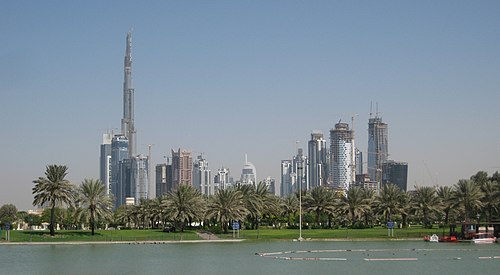
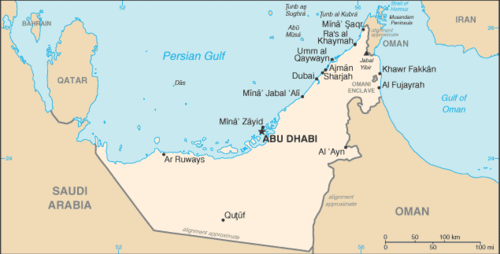
Dubai, the most populous city in the United Arab EmiratesMap of the United Arab Emirates
The table below shows a list of every city in the UAE with a population of at least 10,000, listed in descending order. The capitals are shown in bold. The population numbers are of the cities, and not the emirates, often with the same name. There is also an additional list of the rest of the populated settlements in the UAE under 10,000 (not listed in descending order).[1][2]
^"List of Cities in United Arab Emirates: Area, Population and Cost of Living". Digit Insurance. Retrieved 2024-08-25.
^ abcde"Abu Dhabi Population 2023". census.scad.gov.ae. Retrieved 2024-06-11.
^WAM. "UAE: Sharjah population tops 1.405 million". www.gdnonline.com.
^"190320BR_Ajman Statistic Report_V16_For Print".
^"United Arab Emirates: Emirates & Major Cities – Population Statistics, Maps, Charts, Weather and Web Information".
^ abThe Report: Abu Dhabi 2010. Oxford Business Group. 21 March 2019. ISBN 9781907065217 – via Google Books.
v
t
e
List of cities in Asia
Sovereign states
Afghanistan
Armenia
Azerbaijan
Bahrain
Bangladesh
Bhutan
Brunei
Cambodia
China
Cyprus
Egypt
Georgia
India
Indonesia
Iran
Iraq
Israel
Japan
Jordan
Kazakhstan
North Korea
South Korea
Kuwait
Kyrgyzstan
Laos
Lebanon
Malaysia
Maldives
Mongolia
Myanmar
Nepal
Oman
Palestine
Pakistan
Philippines
Qatar
Russia
Saudi Arabia
Singapore
Sri Lanka
Syria
Tajikistan
Thailand
Timor-Leste (East Timor)
Turkey
Turkmenistan
United Arab Emirates
Uzbekistan
Vietnam
Yemen
States with
limited recognition
Abkhazia
Northern Cyprus
South Ossetia
Taiwan
Dependencies and
other territories
British Indian Ocean Territory
Christmas Island
Cocos (Keeling) Islands
Hong Kong
Macau
Category
Asia portal
v
t
e
Lists of cities in the Middle East
Middle East
Bahrain
Cyprus (Northern Cyprus)1
Egypt
Iran
Iraq
Israel
Jordan
Kuwait
Lebanon
Oman
Palestine (Gaza Strip)2
Qatar
Saudi Arabia
Syria
Turkey
United Arab Emirates
Yemen
1 The Turkish Republic of Northern Cyprus is not officially recognized by the United Nations, recognized only by Turkey; see Cyprus dispute. 2 The Hamas government in the Gaza Strip is not officially recognized by the United Nations, though is recognized as legitimate Palestinian government by several states.
v
t
e
United Arab Emirates articles
History
By period
Prehistory
Glacial period
Hafit period
Bronze Age
Umm Al Nar culture
Wadi Suq culture
Iron Age
Mleiha
Post-Islamic Era
Battle of Dibba
Trucial States
Post-independence
Gulf War
COVID-19 pandemic
By topic
Ancient settlements
Archaeology
Slavery
Postal history
Wars
Military history
Political history
Geography
Cities
Abu Dhabi
Dubai
Climate
cloud seeding
Emirates
Abu Dhabi
Dubai
Sharjah
Ajman
Umm Al Quwain
Ras Al Khaimah
Fujairah
Environmental issues
Geology
Islands
Land reclamation
Mountains
Protected areas
Territorial disputes
Abu Musa
Greater and Lesser Tunbs
Saudi border dispute
Wadis
Wildlife
Invasive species
Politics
Federal
Executive
Cabinet
list
Federal Supreme Council
President
Vice President
Prime Minister
Legislative
Federal Supreme Council
Federal National Council
Elections
2006
2011
2015
2019
2023
Judicial
Supreme Court
Law
Constitution
Nationality
Intelligence
Signals Intelligence Agency
Uniformed
Armed Forces
Air Force
Army
Navy
Presidential Guard
Local
Courts
Abu Dhabi
Dubai
Common law courts
Abu Dhabi
Dubai
Emirate rulers
royal families
Governments
Abu Dhabi
Dubai
Sharjah
Ajman
Foreign relations
Abraham Accords
diplomatic missions
US-UAE nuclear energy agreement
Human rights
blasphemy
capital punishment
freedom of religion
LGBT
migrant workers
Justice system
law enforcement
Legal system
abortion
adoption
cannabis
guns
Visa policy
Economy
Companies
state-owned
Corporate Law
Currency
Entrepreneurship
Finance
banks
central bank
Energy
nuclear
oil
reserves
solar
power stations
Free trade zones
Dubai
Taxation
Tourism
(Dubai)
attractions
Stock exchanges
ADX
DFM
Nasdaq Dubai
Local economies
Abu Dhabi
Dubai
Telecommunications
companies
Internet domain
regulator
telephone numbers
Transport
airlines
airports
bridges
national rail operator
railways
speed limits
registration plates
Society
Culture
Anthem
Architecture
Artists
Cinema
Clothing
Coat of arms
Cuisine
Flag
Heritage sites
Language
Marriage
Mass media
newspapers
television
Museums
Music
National library
Religion
Bahá'í Faith
Buddhism
Christianity
Hinduism
irreligion
Islam (official)
Shia
Judaism
Sikhism
Sport
camel racing
cricket
grounds
esports
events
football
clubs
stadiums
ice hockey
polo
Time
Women
Writers
Conscription
Crime
human trafficking
prostitution
terrorism
Demographics
Education
(Abu Dhabi
Dubai)
schools
universities
Emiratis
Afro-Emiratis
Emirati Americans
diaspora
list
Expatriates
Americans
Armenians
Australians
Canadians
Chinese
Filipinos
Indians
Indonesians
Iranians
Iraqis
Jordanians
Lebanese
Pakistanis
South Africans
Syrians
Health
COVID-19
vaccination
healthcare
hospitals
HIV
Holidays
Commemoration Day
Ramadan
National Day
Flag Day
Outline
Index
Category
Portal
About Desert Buggy Rental Dubai - Dune ATV Quad Bike Safari Tours
Lots of fun driving a buggy in dunes. I would recommend one of the more powerful models. We got a 1000 cc turbo model with 2 seats and it is a really fun machine. Guide Mohsen is super kind, knowledgeable, helpful and takes great photos/videos.
There was a confusion regarding our buggy model, but this was resolved quickly after me pointing out the mistake.
We had no accidents, so I don’t know how the company handles such situations. Keep in mind that there is no insurance which covers damages caused by the driver, so you might be liable for full price of recovery.
From over the phone booking to the pick up on time and the drive in the buggy this company was excellent.
We booked a buggy between us and for my friend who was over from the UK it was the highlight of his stay.
When we went online other companies were charging way more for the same experience so we are so lucky to have found this company.
I would recommend this for anyone who wants to experience driving over the dunes.
Desert Buggy Rental Dubai - Dune ATV Quad Bike Safari Tours, AL FAHAD TOWER - OFFICE 305 - Al Thanyah First - Barsha Heights - Dubai - United Arab Emirates
Desert Buggy Rental Dubai - Dune ATV Quad Bike Safari Tours, AL FAHAD TOWER - OFFICE 305 - Al Thanyah First - Barsha Heights - Dubai - United Arab Emirates
Desert Buggy Rental Dubai - Dune ATV Quad Bike Safari Tours, AL FAHAD TOWER - OFFICE 305 - Al Thanyah First - Barsha Heights - Dubai - United Arab Emirates
Desert Buggy Rental Dubai - Dune ATV Quad Bike Safari Tours, AL FAHAD TOWER - OFFICE 305 - Al Thanyah First - Barsha Heights - Dubai - United Arab Emirates
Desert Buggy Rental Dubai - Dune ATV Quad Bike Safari Tours, AL FAHAD TOWER - OFFICE 305 - Al Thanyah First - Barsha Heights - Dubai - United Arab Emirates
Desert Buggy Rental Dubai - Dune ATV Quad Bike Safari Tours, AL FAHAD TOWER - OFFICE 305 - Al Thanyah First - Barsha Heights - Dubai - United Arab Emirates
Desert Buggy Rental Dubai - Dune ATV Quad Bike Safari Tours, AL FAHAD TOWER - OFFICE 305 - Al Thanyah First - Barsha Heights - Dubai - United Arab Emirates
Desert Buggy Rental Dubai - Dune ATV Quad Bike Safari Tours, AL FAHAD TOWER - OFFICE 305 - Al Thanyah First - Barsha Heights - Dubai - United Arab Emirates
Desert Buggy Rental Dubai - Dune ATV Quad Bike Safari Tours, AL FAHAD TOWER - OFFICE 305 - Al Thanyah First - Barsha Heights - Dubai - United Arab Emirates
Desert Buggy Rental Dubai - Dune ATV Quad Bike Safari Tours, AL FAHAD TOWER - OFFICE 305 - Al Thanyah First - Barsha Heights - Dubai - United Arab Emirates